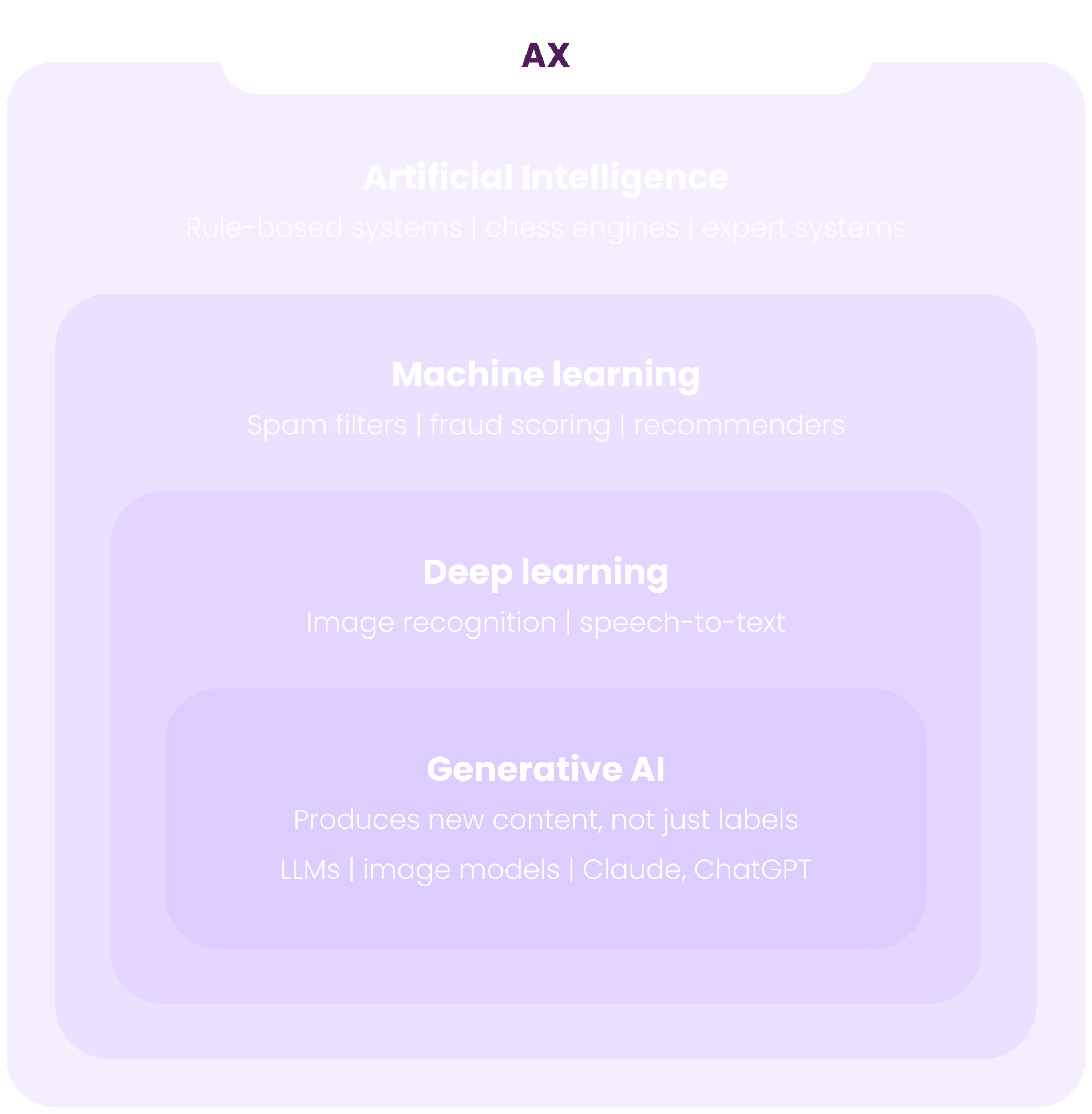
As AI moves from answering questions to taking actions on our behalf, there’s a new discipline emerging alongside UX: AX (Agentic Experience).
AX design branches across two users: the experience AI agents have when interpreting your content, and the experience users have when engaging with AI agents and their outputs.
Designing for trust
Agentic interfaces succeed or fail on trust.
Our own research into digital trust found people want AI to remove friction, not to stand between them and a person when the stakes are high.
It’s critical that we design agents and their outputs to behave predictably, state what they're doing and why in plain language, and follow the flow a person would naturally expect. Autonomy is earned in stages, from suggesting, to acting with approval, to acting independently, with clear checkpoints before anything irreversible happens.
This means your users can have experiences more tailored, efficient, and accessible than ever before. You’ll have all the benefits of a customisable interface experience, while your business can remain confident in its brand reputation, control over offerings, and security.
What this looks like in practice:
- Sandbox modes for regulated workflows.
- Explainable reasoning users can correct in plain language.
- Human-in-the-loop moments designed in from the start, not bolted on after something goes wrong.
Engineering for reliability
AI amplifies engineering fundamentals, it doesn't replace them. Getting real value from these tools requires deep experience in system design, failure modes, and operational discipline. We bring decades of that experience, which is why we can move fast without cutting corners.
We scope tools tightly to what an agent actually needs, build in graceful recovery when a step fails, and log every agent action so it's auditable and distinguishable from human activity. A production agent is a system, not a clever prompt. We connect agents to your data and tools in a structured, secure, and governable way.
This means your systems can adopt emerging capabilities without taking on unnecessary risk.
What this looks like in practice:
- Evaluation and guardrails built into delivery from day one.
- Agents embedded as well-scoped steps inside your existing processes. Never autonomous without boundaries.